
The building was sheet metal-clad on the exterior and interior; partitions separated three small bedrooms from a larger living area; our heat was supplied by a centrally-located wood-burning stove; and a hand pump in the front yard was our source of water.
My father was an ordained Pentecostal minister (converted from Roman Catholicism) who had been sacked from his original posting to a parish in Wellington, Ontario because of theological differences with a dominant quorum of his congregation. God told him, by way of a scripture in the Bible, to leave Wellington and take us all north. We left a three-story, seventeen-room former inn and, after a brief stay in the village of Bancroft, moved four miles farther north and crammed ourselves into the deconsecrated schoolhouse.
The family income at this time consisted of the government "Family Allowance" stipend of eight dollars per child (under sixteen) per month and the meager tithes my father could coax from folks who attended desultory religious meetings he organized, folks whose means were typically even more precarious than ours.
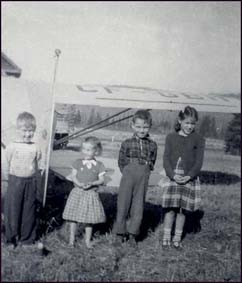
The big mystery to our neighbours -- given our obviously delicate financial circumstances -- was that we owned an airplane. We wore clothing that was given to us, hand sewn by Mom or handed down from an older sibling; and we had just enough food (we relied heavily on an annual vegetable garden) and firewood (free slabwood from local lumber mills) to survive ("God will provide," we were often reminded). Yet we had a four-seat 1947 Piper Clipper tethered to stakes in a nearby farmer's field.
The explanation of this neighbouhood riddle is as follows: prior to his ordination, my father had been a business man -- he owned and operated two successful enterprises: a small cheese factory and a farm animal feed store. With the proceeds from the sales of his businesses -- following the call to the ministry -- he had purchased the house in Wellington. With the money from the sale of that house and the last of his savings he followed the directions of the Almighty -- in spite of our mean circumstances -- and had purchased the airplane.
Late on a spring afternoon in 1953, he circled the schoolhouse in his cream and red Clipper then headed off to the farmer's field where, by prior arrangement, he was to land and we were to pick him up. With tremendous excitement we five younger children raced to the car, a navy 1951 Ford sedan -- purchased at the end of the boom years -- and scrambled for seats. I was last in and, as Mom backed across the sloping front yard in a wide arc, the right front door, which I hadn't closed entirely, swung open and pulled me, tumbling ass-over-teakettle into the yard. My sisters screamed, my mother slammed on the breaks; I rolled about ten feet down the lawn, bounced immediately to my feet and leaped back into the vehicle. Mother, who had been worried sick over Dad's maiden flight in an unfamiliar airplane across the central Ontario wilderness to our home, looked at me with the stricken, haunted look of a woman who had already seen one of her children critically injured under the wheels of a family car (the eldest daughter, Ferne, at eighteen months of age, run over by Dad).
"I'm OK," I said shakely. And pulled the door closed.
A quickly drawn deep breath and a silent thank-you to her Maker and Mother pulled out onto the highway and drove the half mile to a spot on the road, a field's width away from the designated landing strip that would afford us a view of the grand arrival.
Dad circled and circled and circled the property. And we all wondered why. Mother finally discerned what the problem was and pointed it out to us: during the few days Father had been away finding the vendor and purchasing the airplane, the farmer had ploughed the field. As it turned out, Dad hadn't checked out any other landing areas. So -- we quickly realized as the tiny craft settled into an approach run -- he decided to take his chances on the furrowed field he knew.
There was silence in the car as we watched him skim in over the trees at the end of the field. The Clipper hit the ridges of earth, bounced into the air several times, then nosed over into the sod, the propellor splintering into numerous projectiles. The scene of my father's inglorious exit from the plane is recorded in slow motion in my memory: As the Clipper tips over, the tail arching into the air and the prop bits flying, the door under the right wing opens and Dad floats feetfirst to the ground and crumples into a heap. He sits there looking over his left shoulder as the tail of the little craft wavers in the air then very slowly settles to the ground. There is a collective release of breath in the car; Dad struggles to his feet and cautiously circles the plane, limping noticeably from a sprained ankle. Then with head bowed -- more from the bruised ego than the painfully injured ankle -- he hobbles the two hundred yards to his waiting family.
The last of the family's financial resources was spent on CF-GBM because Dad "felt led to bring the Gospel" to a scattering of remote Ontario native Indian reservations and he felt that he could get to them most easily by air. He had trained for his pilot's licence at the time of his ordination and was truly hooked on flying. Over the next two decades he logged hundreds of hours of air time flying into god-forsaken little communities, sometimes at the risk of his life.
But back in Bird's Creek, in 1953, his ownership of an airplane was a profound mystery to the good people who surrounded us. One prevalent rumour was that we were on the payroll of the Chinese communists, that Dad was involved in espionage and was broadcasting secret information to his Chinese contacts by way of radio equipment hidden on the hill behind our house. Those were scarey times for "commies" -- even in an outpost like Bird's Creek -- and being labeled members of the Party was serious innuendo.
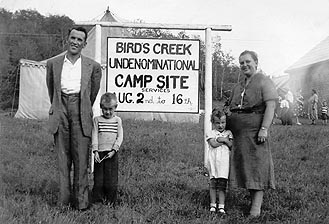
My parents were, in contemporary terms, fundamentalist "born again" Christians. We children were regularly required to attend religious services and prayer meetings, usually seated for hours on hard chairs listening to Dad's "hellfire-and- brimstone" sermons. Once a week, or so, and quite spontaneously, Dad would compel us all to kneel at chairs in the kitchen and, in sequence, from youngest to oldest, or vice versa, pray to God to ask for his blessing and thank him for our great good fortune. I used to dread this ritual: it was embarassing, stressful, weird for me. And for my brothers and sisters, as I recall. We would all be tense and stumble through the short "bless Mom and bless Dad and bless Uncle Bud, etc...." prayer we all parrotted from the sibling who was unfortunate enough to be the oldest or youngest present. Then we would endure a fifteen minute prayer/sermon by Dad, followed by Mother's five minutes of blessings and supplications. When that final "amen" was pronounced, there would be a palpable, collective sigh of relief from us reluctant worshippers as we got to our feet and rubbed our aching knees. I remember exiting the house quickly and racing around the yard and shouting at the sky, ridding myself of the accumulated tension that had stiffened my skinny little body.
Periodically, Father would get the urge to erect a forty by sixty foot tent he had acquired in Wellington and hold a series of nightly "revival" meetings. Our attendance at these gatherings was, of course, mandatory.
Not long after his ordination he had become fascinated by the phenomenon of the great American tent evangelists of the early fifties: Jack Coe, Oral Roberts, A. A. Allen, et al. These charasmatic bombastoids would pack enormous canvas tents with believers, questers, the sick, the half-dead and people-just-out-for-a-good-time as they swept across America in "revival crusades" consisting of week-long stops in farmers' fields near urban centres. All of the evangelists raved in self-published magazines about "outpourings of the Holy Spirit" that resulted in "miraculous healings", "speaking in tongues", "dancing in the Spirit" and "thousands of souls saved". My father had seen A.A. Allen in Niagara Falls, New York and decided he wanted a piece of that action.
In July of 1953 he put his tent up in the yard next to the house in Bird's Creek and spread the word throughout the community that the Lord was in business on our acreage.
The crowds under his canvas were never more than 40 or 50 strong, but lots of fun stuff usually happened. For a five-year old, the sight of stout women falling prostrate on their backs, slain by the spirit in front of the homemade stage; the eerie babbling of glossolalia; the shreiking, leaping dancing in the spirit; and the laying on of hands and (ostensible) healings made for a strange and, in retrospect, sometimes frightening evening.
The toughest and most embarrassing, most ostracizing moments came, however when our young acquaintances caught us standing with Mother and Father as they ministered to the faithless in the open air of a Bancroft (the nearby largest town) street corner on summer Friday nights. Dad would park the Ford on the curb, fasten two large "Jenson horns" to the roof, set up a microphone and we would be required to sing along as he and Mother, playing mandolin and guitar respectively, sang "I've got a mansion just over the hilltop, in that bright land where you'll never grow old..." and other rousing hymns and choruses. Sometimes we would be asked to step forward and sing a solo: my youngest sister sometimes complied; but my obvious look of consternation worked to spare me from that humiliation. After the singing, my father would launch into one of his Bible thumping displays of histrionics, much to the bemusement of the collection of hillbillies, farmers, bush workers and miners who, with their children, shopped and gawked along Bancroft's main thoroughfare come Friday night. My siblings and I hated being part of this sideshow and, when possible, we would drift off to the edges of the small crowd of people who assembled to watch the Lord's officer in action.
My parents' brand of spirituality never worked for me. Even as a child, it felt like a hair shirt that I was forced to wear. I tried to talk to God and feel "saved" throughout my teens, but I never felt the connection that Christian witnesses described. And as I matured, I started to see defects in the basic tenets of the religion that didn't square with my evolving reason, morals and spirituality. And I had no trouble abandoning it completely once I was outside parental dominion.
However, the psychosociological impact of being the child of religious zealots is very deep rooted.
Recently I was riding north in a taxi on Toronto's University Avenue and witnessed a scene that struck a very deep chord in me. A man in a suit stood at the bottom of the Queen's Park lawn, ideally positioned on the edge of the sweep of surging traffic to hold aloft a large homemade sign displaying some cryptic doomsday message written in large red letters. Standing next to him was a boy of not more than 8 or 9 dressed in suit and tie like his (I assumed) father, ranting shrilly through a megaphone at the hurtling automobiles. I caught words/phrases like "Christ Jesus", "eternal damnation", "all sinners", etc. before we swept on around Queen's Park Circle. I became instantly, pathologically infuriated by the scene as witnessed and turned to rave in absolute apoplexy about it to my startled office co-worker, berating the "Jesus freak" father for "ruining his son's childhood", etc., etc. My companion looked me in the eye and asked me why such a relatively benign scene should affect me so dramatically. I explained it as best I could then quickly calmed down and slipped into a rueful silence.
In his book, On the Family, American pop sociologist, John Bradshaw urges that we examine very carefully the things that spark great emotion in us -- be that joy, sorrow, anger or zeal. In my few moments of reverie before the taxi delivered me to my uptown destination, I made the connection between that child in my past and the boy with the megaphone on the Queen's Park lawn... and put one small ghost to rest.
Periodically, Father would get the urge to erect a forty by sixty foot tent he had acquired in Wellington and hold a series of nightly "revival" meetings. Our attendance at these gatherings was, of course, mandatory.
Not long after his ordination he had become fascinated by the phenomenon of the great American tent evangelists of the early fifties: Jack Coe, Oral Roberts, A. A. Allen, et al. These charasmatic bombastoids would pack enormous canvas tents with believers, questers, the sick, the half-dead and people-just-out-for-a-good-time as they swept across America in "revival crusades" consisting of week-long stops in farmers' fields near urban centres. All of the evangelists raved in self-published magazines about "outpourings of the Holy Spirit" that resulted in "miraculous healings", "speaking in tongues", "dancing in the Spirit" and "thousands of souls saved". My father had seen A.A. Allen in Niagara Falls, New York and decided he wanted a piece of that action.
In July of 1953 he put his tent up in the yard next to the house in Bird's Creek and spread the word throughout the community that the Lord was in business on our acreage.
The crowds under his canvas were never more than 40 or 50 strong, but lots of fun stuff usually happened. For a five-year old, the sight of stout women falling prostrate on their backs, slain by the spirit in front of the homemade stage; the eerie babbling of glossolalia; the shreiking, leaping dancing in the spirit; and the laying on of hands and (ostensible) healings made for a strange and, in retrospect, sometimes frightening evening.
The toughest and most embarrassing, most ostracizing moments came, however when our young acquaintances caught us standing with Mother and Father as they ministered to the faithless in the open air of a Bancroft (the nearby largest town) street corner on summer Friday nights. Dad would park the Ford on the curb, fasten two large "Jenson horns" to the roof, set up a microphone and we would be required to sing along as he and Mother, playing mandolin and guitar respectively, sang "I've got a mansion just over the hilltop, in that bright land where you'll never grow old..." and other rousing hymns and choruses. Sometimes we would be asked to step forward and sing a solo: my youngest sister sometimes complied; but my obvious look of consternation worked to spare me from that humiliation. After the singing, my father would launch into one of his Bible thumping displays of histrionics, much to the bemusement of the collection of hillbillies, farmers, bush workers and miners who, with their children, shopped and gawked along Bancroft's main thoroughfare come Friday night. My siblings and I hated being part of this sideshow and, when possible, we would drift off to the edges of the small crowd of people who assembled to watch the Lord's officer in action.
My parents' brand of spirituality never worked for me. Even as a child, it felt like a hair shirt that I was forced to wear. I tried to talk to God and feel "saved" throughout my teens, but I never felt the connection that Christian witnesses described. And as I matured, I started to see defects in the basic tenets of the religion that didn't square with my evolving reason, morals and spirituality. And I had no trouble abandoning it completely once I was outside parental dominion.
However, the psychosociological impact of being the child of religious zealots is very deep rooted.
Recently I was riding north in a taxi on Toronto's University Avenue and witnessed a scene that struck a very deep chord in me. A man in a suit stood at the bottom of the Queen's Park lawn, ideally positioned on the edge of the sweep of surging traffic to hold aloft a large homemade sign displaying some cryptic doomsday message written in large red letters. Standing next to him was a boy of not more than 8 or 9 dressed in suit and tie like his (I assumed) father, ranting shrilly through a megaphone at the hurtling automobiles. I caught words/phrases like "Christ Jesus", "eternal damnation", "all sinners", etc. before we swept on around Queen's Park Circle. I became instantly, pathologically infuriated by the scene as witnessed and turned to rave in absolute apoplexy about it to my startled office co-worker, berating the "Jesus freak" father for "ruining his son's childhood", etc., etc. My companion looked me in the eye and asked me why such a relatively benign scene should affect me so dramatically. I explained it as best I could then quickly calmed down and slipped into a rueful silence.
In his book, On the Family, American pop sociologist, John Bradshaw urges that we examine very carefully the things that spark great emotion in us -- be that joy, sorrow, anger or zeal. In my few moments of reverie before the taxi delivered me to my uptown destination, I made the connection between that child in my past and the boy with the megaphone on the Queen's Park lawn... and put one small ghost to rest.