
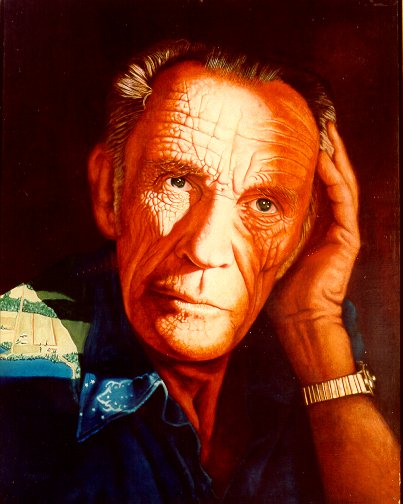
He was born on September 4, 1911, at Prescott, Ontario, received his public school education near Mainsville, then began his working career as a labourer on farms, in the bush and in cheese factories here in Eastern Ontario. He married Mom, Sadie Pyke on June 24, 1936 and became a father eight times over between 1937 and 1949. He attended and graduated from Kemptville Agricultural College in 1943; owned and operated a cheese factory and a feed store in Prescott, Ontario, while raising livestock and poultry on our small family farm at Domville; attended Bible college in Elim, New York; was ordained and began his ministry at a Pentecostal church in Wellington, Ontario in 1951 -- where he also operated a small grocery store, then a garage for a short time; moved to Bancroft and established a ministry in 1953; embarked on missionary trips to native Indian reservations in Ontario and poverty-stricken areas of the Caribbean Islands of Cuba, Jamaica and Haiti. And with the help of some family members -- chiefly Mother and Arthur -- operated a number of rural route and highway mail delivery services as well as school bus routes in the Bancroft area in the 60s, 70s and 80s. By 1989 he had divested himself of all the businesses and retired. And in 1992 he and Mother moved to Morrisburg.
His major passions were missionary ventures, languages, flying his light airplanes and working outdoors.
Shortly after his ordination Dad decided he wanted to be a missionary to Japan so he began planning for the big move and learning Japanese from language course records. Unfortunately for him, the Americans were not permitting missionaries into Japan at that point in time and his plans had to be abandoned. His mission work really got under way with visits to Ontario native Indian reservations in the mid-1950s. And his international junkets started in 1959 with a visit to Cuba. Over the next three decades he expanded his missionary ventures to include Jamaica and Haiti where he preached and provided financial support to various Christian enterprises and individuals. In order to communicate more effectively with his contacts in these locations, Dad happily pursued his love of languages. He learned passable Spanish for his visits to Cuba and upgraded his French during the time he spent in Haiti. He truly enjoyed meeting and communicating with people of different lands, people of different cultures. He was even intrigued by the varieties of dialects of the English language that are found in Ontario communities and was very good at mimicking them.
While studying for the ministry in 1951, Dad took airplane ground school training and, later, flying lessons in Ottawa and received his pilot's license. In 1953 he purchased a 4-seat, single engine Piper Clipper airplane and used it for mission trips to Indian reservations and for expeditions to places as far afield as New Brunswick and Nova Scotia. He had a charmed career as a flyer (Mom would say, probably rightly, that he was protected by the angels that she asked to fly with him). But his adventures and misadventures were numerous. One of my most memorable summer holidays was a trip in the plane with Dad to Newcastle and Back Bay, New Brunswick where he preached at a series of "revival meetings". We slept in a shed at Megantic, Quebec after being forced to land because of bad weather; got called onto the commanding officer's carpet at an Air Force base in Nova Scotia when we misunderstood landing instructions and interrupted the flight schedules of the giant Argus submarine-detecting aircraft; and we were lost for more than half an hour in the dense mountains of northern Maine on the way home when our compass -- or, more probably Dad's sense of direction -- malfunctioned. But, it was high adventure for a thirteen-year-old and a summer vacation to remember.
When I think of Dad at his most contented I see him out-of-doors: gardening, mowing lawns, fiddling under the hood of a car in the front yard, working in the bush with a chainsaw, splitting and stacking firewood. He enjoyed nature and its creatures. He loved the fields and hills and marsh of the property in the Maxwell Settlement and all the birds and small animals that populated it -- maybe with the exception of the beavers who he fought to a draw over the dam they kept building in the pond next to the forty acre field. He was a man who was always busy at some chore or other -- I don't recall seeing him indulge in any kind of purely leisure activity: working around his property was the closest he would come to recreation.
He had numerous friends, associates and acquaintances: eccentric evangelists, Christian "brothers" and "sisters", fellow mail and school bus contractors and scores of people in his missionary destinations.
He was a little man but, as a child, I recall, he loomed large over me -- a physical and psychological presence that, in retrospect mostly engendered apprehension more than affection. I wish I could, but I don't ever recall him comforting me, reading to me, playing games with me, taking an interest in my schoolwork or asking me about my aspirations. It was my impression that we eight children were more tolerated than cherished. Maybe that's a harsh judgement; maybe he was simply a typical busy father of his generation. But, I am forced to conclude that he was also typical of those people with missionary zeal who have large amounts of energy, affection and resources to spend on needy people half a world away, but give the minimum to their family, who need it the most.
I have taken all of these points very much to heart with regard to my own parenting.
There were, ostensibly, reasons why he related to us as he did: he had a very traumatic childhood: his father died when he was eleven years-old; he was abandoned to an orphanage for a time; he suffered a bout of polio that left one leg partially paralyzed; and he spent his youth and early adulthood in serious poverty. Some people rise above conditions like these. But for Dad, the hardships of his youth conspired to create a man with a compensating over-inflated sense of self and a surprising insensitivity to those to whom he should have been closest.
The saving grace for my brothers and sisters and l was that Mother has always had love and commitment to spare and thanks to her we all survived and became relatively competent, productive adults. But we, Lawrence's children, are all poorer because of the absence of paternal involvement and manifest affection.
He had his failures as a husband, as a father and as a human being. But, to be fair he also had a set of positive attributes he passed on to his sons and daughters: he was a hard worker, ambitious, fiercely independent, self-sufficient and possessed of a good dose of common sense. In spite of his serious approach to life and his solemn religious persuasion, he had a sometimes lively sense of humour -- although it tended towards (and, thankfully, none of us inherited) the appreciation and use of terrible puns, plays-on-words and corny jokes.
Lawrence O'Marra's biggest achievement, in my humble opinion, was courting and then marrying the beautiful and faithful Sadie Edith Pyke. Mother was a slender sixteen-year old when she embarked on a long and winding road with a difficult and demanding man. Her young motherhood was a blur as she bore nine children in 13 years, maintained home and garden and stood by him through six mostly lean and arduous decades. Although she would credit her faith in God for getting her through the tough times, she had to have had a strong sense of self and indomitable willpower to have survived the adversities, the complexities, the tribulations of life with the man who was initially attracted to her Hawaiian guitar, but was lucky to have found and captured a genuinely great soul.
Mother, you can take pride in knowing that you contributed greatly to his achievements, and that you also supported him generously when he failed. Even though he may too often have taken you for granted, hurt you by word and deed, resented your accomplishments and insights -- and especially your close relationships with all your children... in spite of all this, I believe (and he told you more and more toward the end) that he did truly love and appreciate you -- as much as his crippled soul would allow.
And for us, his children, he never expressed it often enough -- or maybe, to some of you, he never expressed it directly at all -- but, he did love us and admire us for our accomplishments. He committed his life story to video tape for me several years ago and at one point in his monologue -- and with great emotion -- he declares: " I'm happy for the family God gave us, the children he gave us because there isn't one of them... [who] isn't a better [person] than I am. I think they're all good children.. living good lives..
In closing I would like to recount an incident that happened between Dad and me twenty or so years ago that gave me an insight into the person he could have been -- perhaps I should rephrase that: the father I personally yearned for.
We were sitting in the living room of the old schoolhouse back in the Maxwell Settlement and I was holding forth on some topic that was interesting to me -- and quite obviously intriguing for him -- lost in the excitement of the idea, when I noticed that he was smiling at me with tears in his eyes. I was a little taken aback.. and asked, "Why the tears?"
"I'm just feeling blessed that I'm learning something new from you," he said with emotion and appreciation, wiping the tears from his eyes.
For a man who preached and taught and rarely listened to most people (and especially to his children), I recognized that it was a very rare and meaningful moment.
I could remember him as the father who, emotionally speaking, and often physically, as well, wasn't there for me. But, I will choose to remember him as he was at that moment: my father who loved and appreciated and respected me.
Good-bye Dad.
Allan O'Marra
June 24, 1996